

Sump Pump Check Valves
Keep the water in your discharge pipe from falling back into the pit every time the pump shuts off.
Standard check valves
A full-flow flapper valve with flexible couplings and stainless steel clamps. Threaded models screw onto the pump. Slip models go in the discharge line.
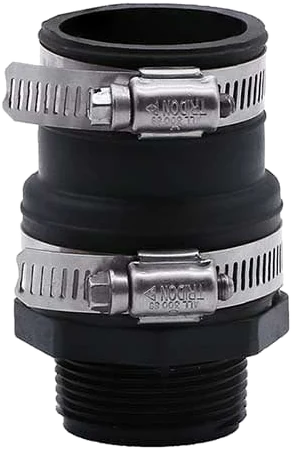
Threads onto the pump
1-1/4″ male pipe thread on the pump end. The coupling fits 1-1/4″ or 1-1/2″ discharge pipe.
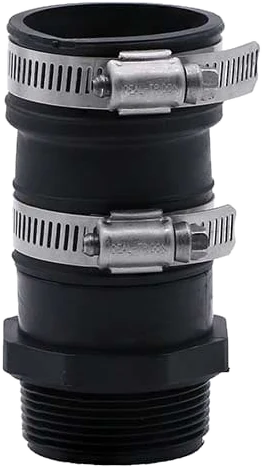
Threads onto the pump
1-1/2″ male pipe thread on the pump end. The coupling fits 1-1/4″ or 1-1/2″ discharge pipe.
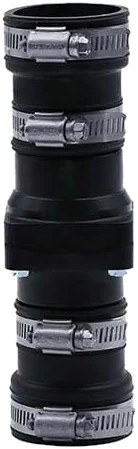
In the discharge line
Couplings on both ends fit 1-1/4″ or 1-1/2″ pipe.
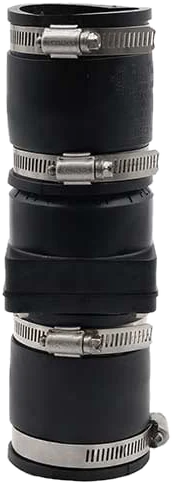
In a 2″ discharge line
Couplings on both ends fit 2″ pipe.


ProCheck Quiet Check Valve
QCV-150 · 1-1/2″
The quiet choice for finished basements and anywhere pump noise carries.
- Whisper quiet. The spring-loaded flapper closes as the pump stops, without the thud of a standard flapper.
- Clear body. See the water move and check that the valve is seated.
- Stainless steel shielded couplings. They resist pipe vibration and movement, and ridges inside grip the pipe.
- Installs vertical or horizontal on 1-1/2″ discharge pipe.
How to install
A screwdriver, nut driver or socket wrench tightens the clamps.
- Thread the valve into the pump discharge.
- Set the pump in the pit and slide the coupling over the discharge pipe.
- Tighten the clamp.
- Cut the discharge pipe where the valve will go, just above the pit.
- Slide the couplings over both pipe ends with the flow arrow pointing up, away from the pump.
- Tighten the clamps.
Check your pump manual for a weep hole. Most call for about a 3/16″ hole in the pipe between the pump and the check valve, so air can’t lock the pump. If you have two pumps, give each one its own check valve.
Sizes
| Part | Pump end | Pipe end | Valve |
|---|---|---|---|
| CV-125T | 1-1/4″ MPT | 1-1/4″ or 1-1/2″ | Flapper |
| CV-150T | 1-1/2″ MPT | 1-1/4″ or 1-1/2″ | Flapper |
| CV-150 | 1-1/4″ or 1-1/2″ | 1-1/4″ or 1-1/2″ | Flapper |
| CV-200 | 2″ | 2″ | Flapper |
| QCV-150 | 1-1/2″ | 1-1/2″ | Spring-loaded, coming November 2026 |
Specifications
| Use | Sump pump discharge lines |
| Valve (CV models) | Full-flow flapper |
| Body (CV models) | Thermoplastic |
| Couplings (CV models) | Flexible PVC with stainless steel clamps |
| Valve (ProCheck) | Spring-loaded flapper |
| Body (ProCheck) | Clear ABS |
| Couplings (ProCheck) | ProFlex with stainless steel shields and clamps |
| Size (ProCheck) | 7-1/4″ tall x 3″ wide |
| Tools | Screwdriver, nut driver or socket wrench |
Common questions
Why does a sump pump need a check valve?
Without one, the water in the discharge pipe falls back into the pit when the pump stops, and the pump has to move it again. The check valve holds that water in the pipe, which helps reduce short cycling.
Threaded or slip?
Threaded models (CV-125T, CV-150T) screw straight into the pump discharge. Slip models (CV-150, CV-200, ProCheck) go in the discharge line above the pit. Match the size to your pump discharge, and don’t go smaller than it.
Which way does it go?
With the flow arrow pointing up, away from the pump.
Why does my check valve thump when the pump shuts off?
A standard flapper closes when the water starts to fall back, and that can cause a thud in the pipe. A spring-loaded valve like ProCheck closes as the pump stops, which is quieter.
Do I need a weep hole?
Most pump makers call for one: about a 3/16″ hole in the pipe between the pump and the check valve, so trapped air can’t keep the pump from moving water. Some pumps have one built in. Follow your pump manual.
Can two pumps share one check valve?
No. Give each pump its own check valve, or water can flow back through the pump that isn’t running.
Documents and downloads
The check valve product sheet and the catalog page.

